CTRify isn’t just another AI tool throwing out generic articles.
CTRify uses real SEO data to create content that affects rankings and authority. Give it a keyword like “fishing with lures,” and it pulls relevant questions, subtopics, and competitor info. The output covers the topic fully and aligns with what search engines and users look for.
The way CTRify works is straightforward but powerful.
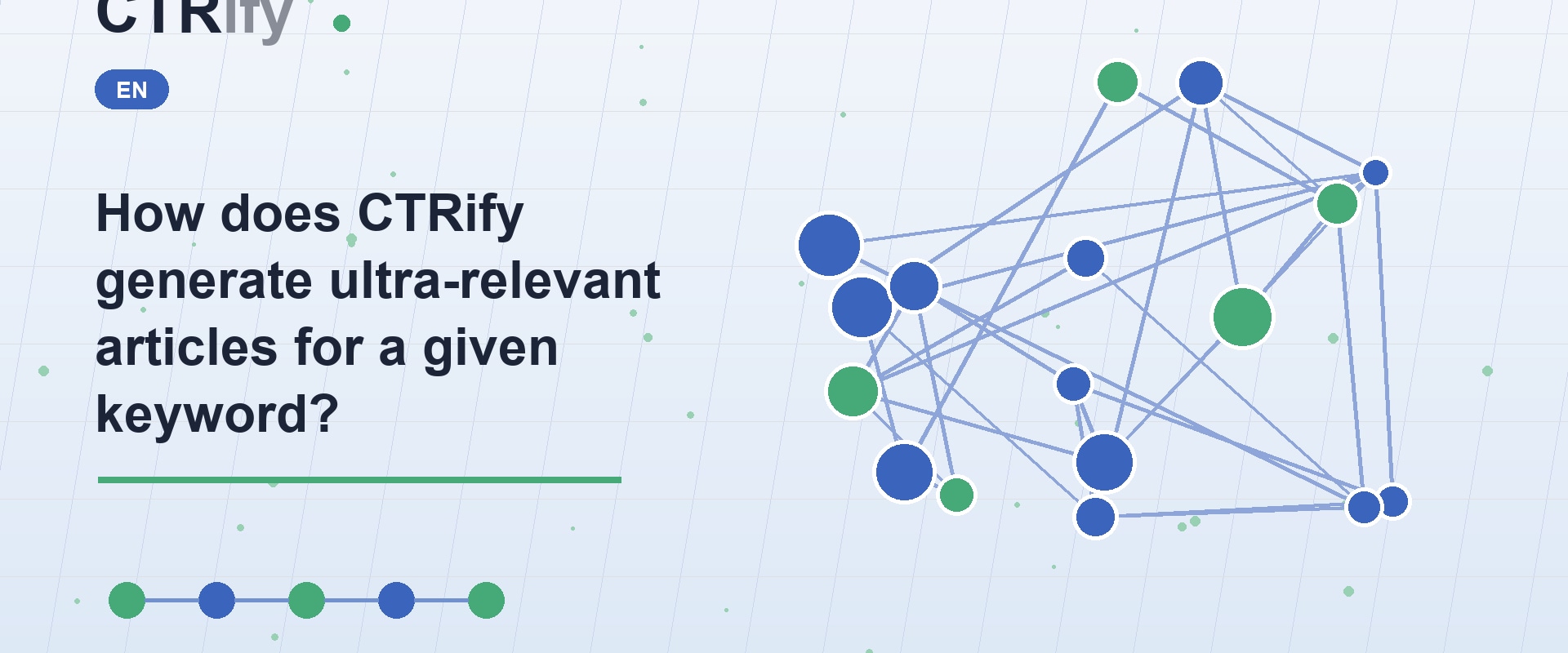
It applies machine learning to map the semantic field around your keyword, understanding related terms, user intent, and competitor gaps. Then it creates multiple articles targeting different angles of “lure fishing,” building a content network that supports main pages and strengthens topical authority for better Google rankings.
But content alone isn’t enough.
CTRify applies SEO best practices in every article: keywords in titles, meta descriptions, headers, and naturally in text. It also manages on-page SEO like internal linking and schema markup, based on proven tactics from hundreds of campaigns that have improved rankings and earned featured snippets.
One of the biggest challenges in SEO is building credible backlinks.
CTRify addresses this by adding links from authoritative, trusted sources within the content. These semantic links improve domain rating (DR) and domain authority (DA), strengthening your site’s trust signals to Google, which is key in competitive niches.
User engagement signals are another area where CTRify shines.
Google tracks CTR, dwell time, and bounce rates, which affect rankings. CTRify creates content that answers questions clearly and keeps visitors engaged. Clients have seen better organic CTR and dwell time after using CTRify, which correlates with improved rankings.
Speed and ease of deployment are often overlooked in SEO tools, but not here.
CTRify can launch a fully hosted, SEO-optimized website in minutes. No need for developers or complex setups. Hosting, mobile optimization, and backend SEO are handled by the platform, letting you test keywords and content ideas faster than traditional methods.
Mobile optimization is baked into CTRify’s process.
With traffic from mobile and desktop devices worldwide, CTRify ensures sites perform well across all screens. This matters because Google uses mobile-first indexing. Fast-loading, mobile-friendly sites get better visibility, and CTRify makes sure your site meets those standards.
We’ve seen CTRify projects push visibility and rankings for clients across various industries.
This isn’t guesswork. It’s controlling the signals Google watches—semantic relevance, authority links, UX metrics, and indexation. You build a network of pages supporting main URLs, backed by data and SEO experience instead of just publishing content and hoping for traffic.
If your current content strategy feels like shouting into the void, CTRify offers a way to get Google’s attention where it counts.
It’s about creating content that earns traffic, supported by signals Google values. That’s why many clients use CTRify to improve their rankings in competitive search results.
Check out CTRify SEO website workflow to see how this works in practice and start building content that moves rankings, not just fills pages.
What makes the article relevant
Relevance starts before the first paragraph. CTRify looks at the keyword as a search problem, not as a writing prompt. The article needs to answer the query, connect with related entities, support the target URL and give Google a cleaner picture of what the page should rank for. That is why a useful CTRify article is not just a block of text. It becomes part of the site’s semantic structure.
The professional SEO team should think in layers. First, the article has to match the intent behind the keyword. Then it needs headings that answer real questions, internal links that point to the right commercial pages and context that connects the topic to the rest of the domain. After that, CTRify can add authority and UX/CTR signals around the URLs that deserve more visibility. Those layers are what make a content campaign stronger than publishing isolated posts.
How CTRify turns one keyword into a campaign asset
A keyword like “local SEO software for agencies” can become more than one article. It can support a feature page, a comparison page, a case-style post and a cluster of related questions. CTRify helps build that structure so every piece has a job. One article earns long-tail traffic. Another reinforces the main service page. Another gives the site topical depth. Together, they make the domain harder to ignore.
Search Console then tells the professional SEO team what is working. If the article starts collecting impressions for related queries, that is a signal to strengthen it with links, improve its snippet or connect it more directly to a money page. If the page gets seen but not clicked, UX/CTR work gives the SEO team a way to make the campaign read cleaner. If the topic is too thin, the answer needs more depth. CTRify gives a way to act on that data instead of guessing.
The commercial reason to use CTRify content
Most AI content stops at “write an article.” CTRify should be used differently. The goal is to create content that supports rankings, authority and conversion paths. A good article brings a human answer. A strong CTRify article also sends semantic signals, supports internal relevance and gives the SEO team a page that can be pushed with real SEO activity. That is the difference between filling a blog and building an asset around a keyword.