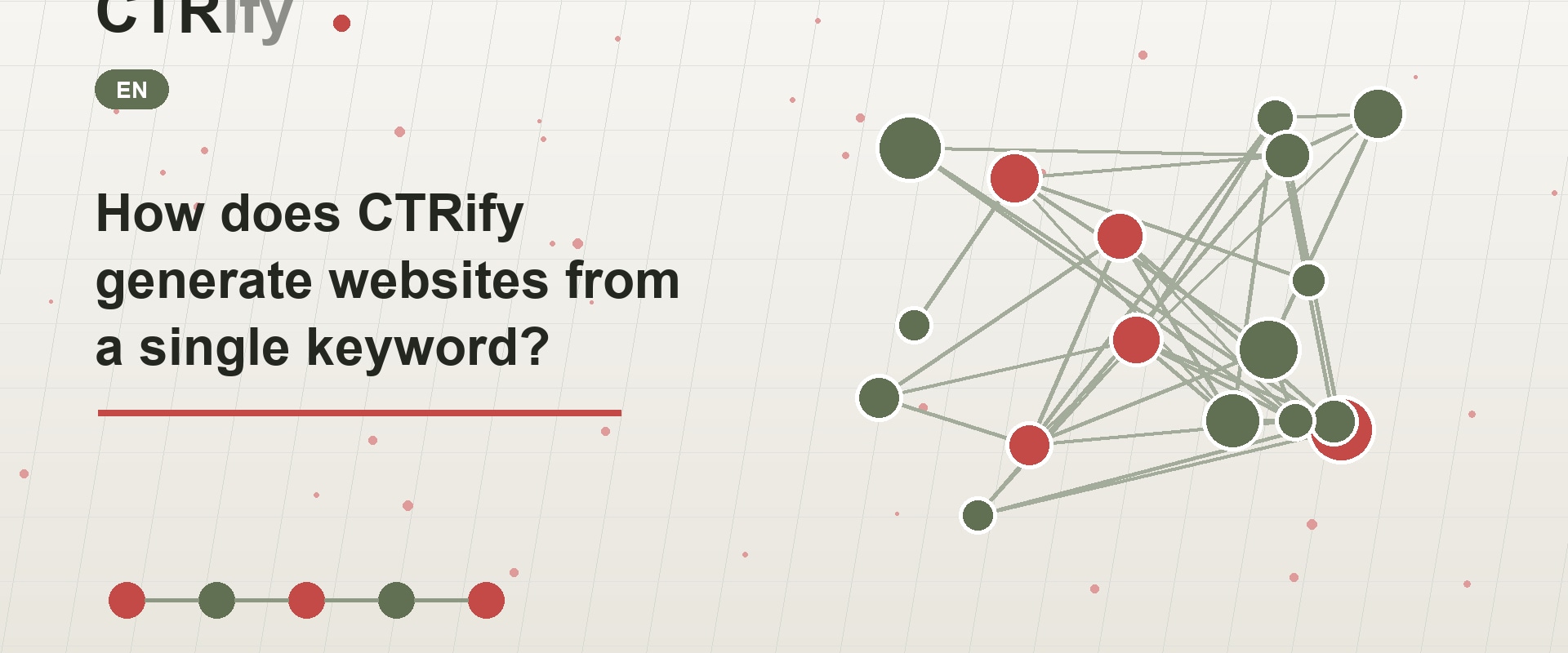
CTRify can generate a website from a single keyword, but the useful part is not the word count or the speed. The useful part is that the keyword becomes a working SEO surface: pages, posts, metadata, internal links, topical structure and a place where you can build signals. A keyword on its own is just an idea. CTRify turns it into a site you can operate, measure, edit and use to support the URLs that matter.
The keyword is the starting point, not the whole strategy
One keyword can carry a lot of meaning. It can be a service, a product category, a local search, an affiliate topic, a SaaS problem, or a question people ask before buying. CTRify starts from that keyword and builds around the intent behind it. That matters because Google does not rank a keyword in isolation. It ranks pages that satisfy a search and belong inside a clear topic.
If the keyword is “lure fishing,” the site should not only repeat that phrase. It should cover techniques, lure types, seasonal searches, buyer questions, comparisons, beginner mistakes and the commercial paths that matter for an online fishing store. That is how a generated site becomes useful. It builds enough context for the target topic to look real.
How CTRify expands the topic
CTRify uses the keyword to produce related questions, supporting articles and page angles. The AI can map the obvious queries around the subject and create content that gives the site a wider footprint. This is useful because most weak SEO sites have the same problem: one page tries to do the work of an entire topic.
A better structure gives Google more to read and gives users more reasons to stay. The main page can be supported by posts that answer long-tail questions. Internal links can point from those posts toward the page that deserves attention. Related content can build the semantic field around the keyword. The site starts to behave like a small topical asset instead of a single generated page.
Generated pages still need professional SEO judgment
The first generated version is not something you should publish blindly and forget. That is how low-quality AI content ends up looking exactly like low-quality AI content. CTRify gives you the base, but the SEO team still has to make decisions: which page is commercial, which post supports it, which title deserves rewriting, which internal link path is useful, and which sections need more proof.
This is the difference between pushing a button and running an SEO campaign. A generated website can be edited. Titles, meta descriptions, headings, body copy, links and calls to action can be improved. If a page starts getting impressions for a better query than expected, the site can be adjusted. If a post is too thin, it can be expanded. CTRify gives you the surface. The campaign comes from how you work it.
Metadata gives the generated site a clearer search face
Titles and descriptions matter because they are often the first thing a searcher sees. A generated site needs metadata that matches the keyword intent without sounding fake or stuffed. The title should make the page worth clicking. The description should explain the value. The headings should keep the promise once the visitor lands.
CTRify lets the SEO team keep that layer aligned with the campaign. If Search Console shows impressions but weak CTR, the title and meta need attention. If users click and leave quickly, the page may not answer the query well enough. A single keyword can start the site, but the metadata and content have to keep the site honest.
Internal links turn content into structure
A generated site becomes stronger when its pages are connected with purpose. Internal links tell Google which pages matter and how the topic is organized. They also help users move from informational content toward the commercial page, product page, service page or guide that matters most.
CTRify can support that work by giving the SEO workflow posts and pages that actually have something to link from. A question article can point to a main guide. A comparison page can point to a product category. A beginner post can point to a service page. The site stops being a pile of articles and starts becoming a topic map.
Semantic backlinks add external support
Once the generated site is clear, semantic backlinks can add authority and context. This is where CTRify becomes more than a site generator. The site can support a money URL, receive relevant links, or become part of a wider network of topical assets. The link has more value when the source page, anchor and target page all make sense together.
Authority metrics like DR and DA are not the only goal, but they help show whether the site is gaining weight. More important is whether the links are connected to content that deserves to exist. CTRify works best when the generated pages, internal links and external support all point in the same direction.
Search Console decides what happens next
After the site is generated and indexed, Search Console becomes the SEO team’s feedback loop. Are pages getting impressions? Which queries are appearing? Is CTR weak? Are rankings moving? Is Google testing only long-tail content or starting to test commercial terms too?
Those answers decide the next action. Maybe the title needs work. Maybe the site needs more support articles. Maybe the money page needs stronger internal links. Maybe semantic backlinks should be added. Maybe the URL is ready for UX and CTR signals. CTRify gives you more controls, but the data should decide which control gets used.
When UX and CTR signals make sense
UX and CTR signals are useful when there is a real search surface to work with. If a page has no impressions and no clear intent, the first job is content, indexation and authority. If a page is showing up but losing the click, the snippet, page promise and user path need attention. If the page is being tested around positions where movement is possible, behavior signals can matter more.
This sequence is important. CTRify is not about pretending every keyword instantly ranks because a site was generated. It is about creating the structure, building the signals, watching the data and pushing the URLs that deserve more visibility.
The practical answer
CTRify generates websites from a single keyword by turning the keyword into a site structure: content, metadata, posts, internal links, semantic context and measurement. The keyword gives direction. The SEO team gives judgment. The campaign gives the site weight over time.
If you have a keyword that matters commercially, use it as more than a prompt. Use CTRify to build a site around it, clean up the structure, connect the links, measure what Google tests and add the right signals when the URL is ready. That is how one keyword becomes an SEO property you can actually work with.