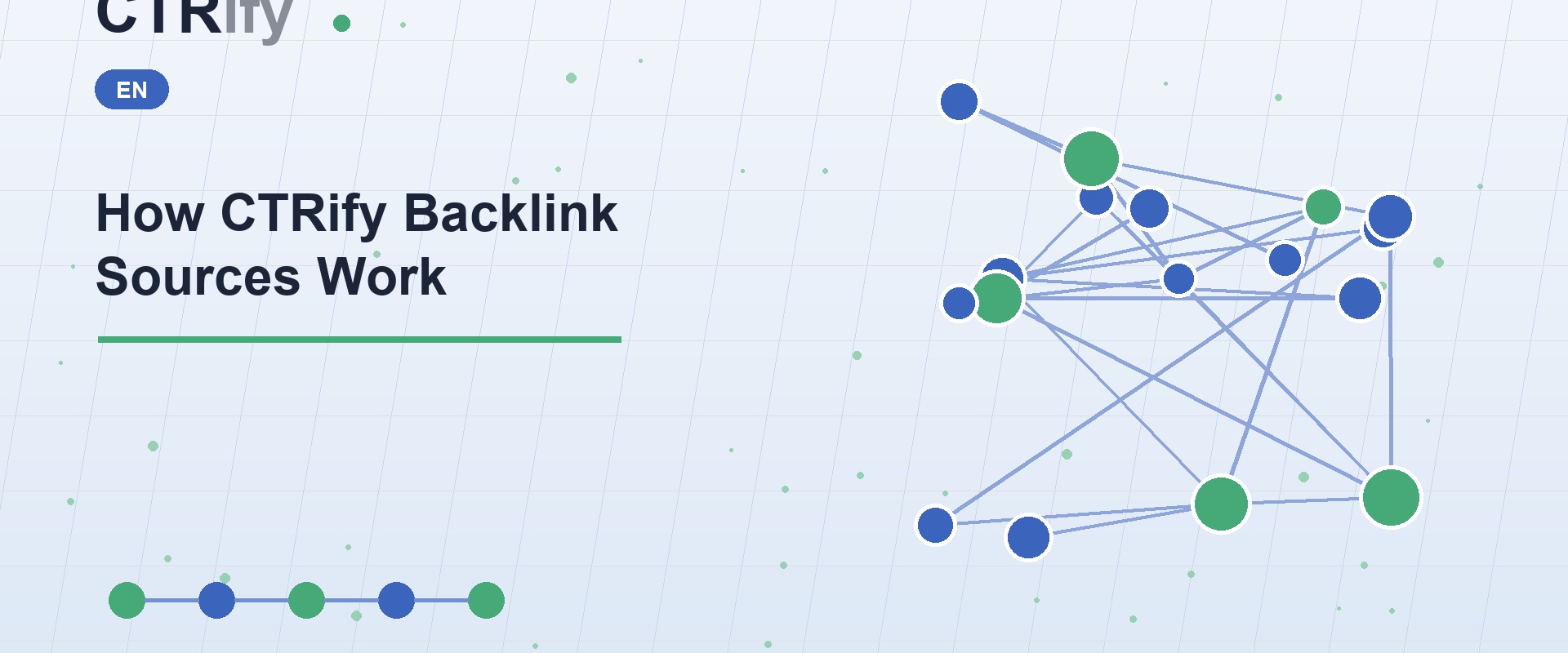
CTRify’s backlink solution works by building better sources for the link, not by throwing random links at a target URL. That distinction matters. A backlink is useful when the page around it explains the topic, the site has a reason to exist and the link points to a URL that belongs in that conversation. CTRify gives professional SEO teams a way to create that environment deliberately.
The old backlink game was often too shallow: buy a placement, check a metric, paste the link into a report and hope Google reads it kindly. CTRify is built for a more complete job. It creates supporting websites and articles around the keyword, connects them with semantic links, sends authority toward the target page and adds UX/CTR activity around the campaign so the link is part of a wider SEO signal.
The Source Comes First
A weak source makes a weak backlink. If the supporting page has no topical connection, the link has little meaning. CTRify starts by building the source around the topic. If the target page is about AI SEO software, the support content should talk about rankings, semantic backlinks, UX signals, CTR campaigns, Search Console movement and agency workflows. If the target page is about lure fishing, the source should sit inside fishing content, not a random unrelated site.
That is the practical advantage. The backlink is surrounded by words, pages and internal links that support the same idea. Google gets more context. The target URL gets a cleaner signal. The SEO team gets a link source that can be measured instead of just counted.
Semantic Links Carry The Message
CTRify uses semantic links because anchor text alone is not enough. The meaning around the link matters: the paragraph, the heading, the page topic, the internal links and the relationship between the source and target. A semantic backlink tells Google why the target page is relevant, not only that it exists.
This is why CTRify backlink sources are built as content assets. An article can answer a real query, connect to related pages and point to the commercial URL in a way that makes sense. The link becomes part of the explanation. That is stronger than a sidebar link, a footer link or a placement on a page that has no reason to mention the target.
Authority Flow Has To Be Directed
Backlink work is not just about getting links into a source. It is also about directing authority out of that source. CTRify lets the SEO team decide which target URLs deserve support and how the link paths should be built. The supporting site can collect relevance around the topic and then pass that relevance toward the page that needs movement.
DR and DA are not the only metrics that matter, but they are useful signs when authority is building. A CTRify backlink campaign should also be watched through rankings, impressions, indexation and query expansion. The strongest campaigns show movement in several places at once: better long-tail coverage, stronger target-page visibility, more stable positions and a clearer authority profile.
UX And CTR Signals Add Weight
Links do more when the pages around them are alive. CTRify can add residential IP activity and UX/CTR signals around the campaign so the support layer has behavior, not just HTML. Google reads how users interact with search results and pages. A source that gets indexed, clicked and used has a different profile from a dead page created only to hold a link.
The behavior layer is not a replacement for relevance. It works best when the content and links already make sense. CTRify’s role is to stack the signals: topical source, semantic link, authority path, residential traffic pattern, CTR activity and Search Console data. That is how a backlink source becomes part of an SEO system.
What The SEO Team Measures
After the backlink source is live, the SEO team should not just ask whether the link exists. The better questions are: is the source indexed, is the support content getting impressions, is the target URL gaining long-tail queries, is CTR improving, are snippets changing, are rankings more stable, and is DR/DA moving in the right direction?
Search Console is useful here because it shows whether Google is reading the new relationship. Ranking tools show whether the target URL is reacting. Crawl and indexation checks show whether the support layer is being accepted. If those indicators move together, the backlink is doing real work.
Why This Beats Random Link Building
Random link building often creates noise. It may add numbers to a report, but it does not always add a reason for Google to trust the target page. CTRify is better because the backlink source is designed around the campaign from the start. The topic, the article, the internal links, the anchor and the target URL all belong to the same plan.
That matters in competitive SEO. Competitors are not only building links. They are publishing content, testing snippets, creating CTR pressure and trying to control the SERP conversation. CTRify gives you a way to answer with assets that explain your page, support your authority and make your ranking signal harder to dilute.
The Commercial Answer
CTRify’s backlink solution works by turning backlinks into controlled SEO assets. You build the source, create the relevant content, add semantic links, direct authority toward the page that matters and track the result. It is cleaner than buying random placements and stronger than waiting for natural links to appear when competitors are already moving.
If a page deserves to rank, give it support that Google can understand. CTRify builds that support with contextual backlink sources, content depth, UX/CTR activity and measurable data. That is how backlink work becomes a ranking system instead of a monthly link count.