CTRify is an SEO operator tool focused on fixing ranking issues by identifying bottlenecks, creating or improving assets, supporting specific URLs, testing user behavior, and delivering measurable results. It’s about consistent SEO operations, not just faster content production. CTRify helps agencies build AI-driven sites, content clusters, backlink assets, internal links, UX/CTR tests, and manual CTR experiments based on client priorities. Agencies get a clear workflow starting from one client URL or market gap to decide if the next step is content, support assets, link building, UX/CTR, or performance measurement.
What agency problem does CTRify solve first?
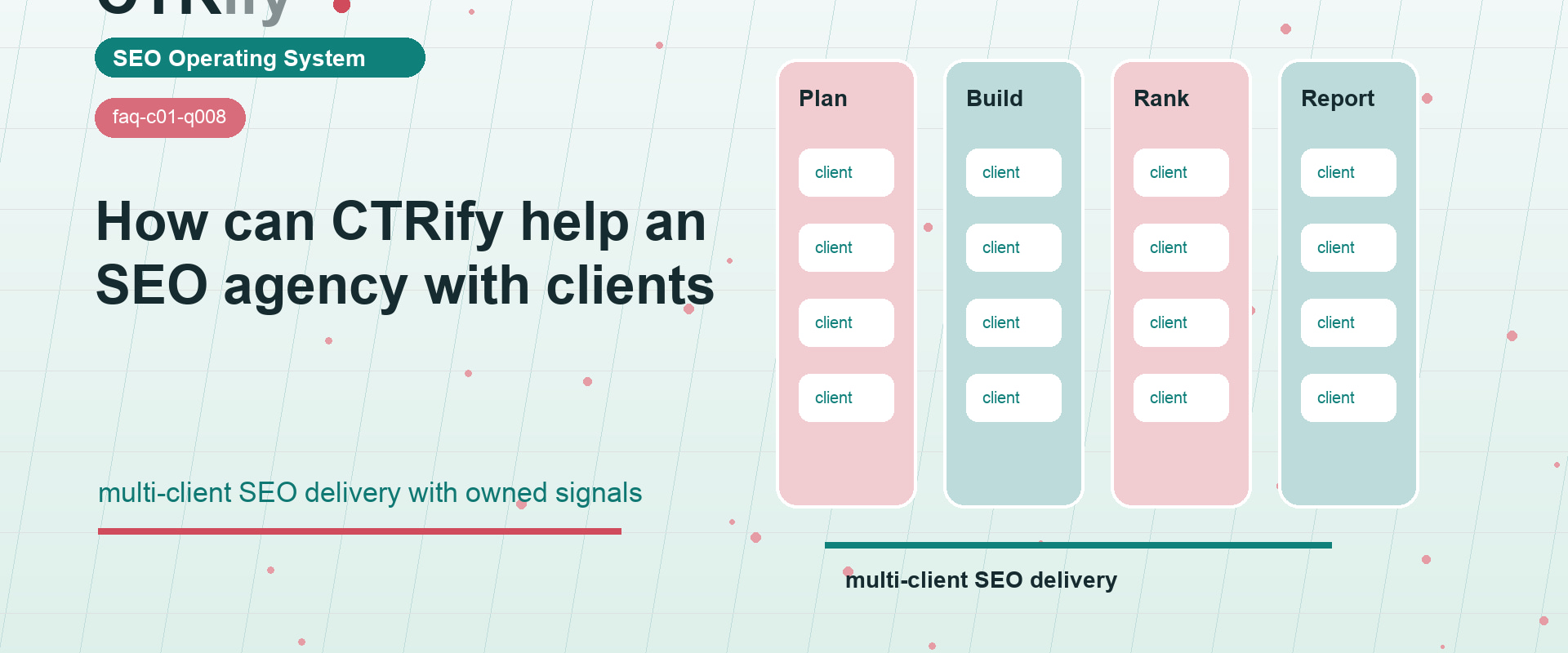
The main issue CTRify addresses is slow delivery. Agencies often have solid SEO strategies but get stuck on research, briefs, content creation, link building, technical checks, and reporting per client. CTRify breaks delivery into modules: SEO Machine for content and query targeting, AI Websites and SuperSite for owned assets, External Links Manager for backlinks, and UX Signals for pages with search traffic.
For US agencies working with local service, SaaS, or affiliate clients, this matters because margins rely on efficient, repeatable delivery. Agencies use the Client Asset Ladder: audit the live URL, decide if a new asset is needed, add support only after URL readiness, then test user behavior after visibility. This workflow prevents wasted effort and credit on premature stages.
How can CTRify create assets an agency controls?
CTRify generates assets agencies fully control by producing AI websites, structured SuperSites, and topical support properties targeting niches. These owned assets allow agencies to manage topic focus, page hierarchy, internal linking, publishing schedule, anchor texts, and future references. This contrasts with guest posts or placements that competitors can also obtain.
One CTRify-generated site achieved 389,207 pageviews with 61 posts and a Domain Rating (DR) of 50. DR isn’t a ranking guarantee but owning a support property provides a reusable SEO surface, a link source, topical relevance, and a testing ground for lead generation.
When should an agency use CTRify for client backlinks?
Use CTRify for backlinks only when the target page has a clear role and needs contextual link support. Links won’t fix weak or irrelevant pages. The process is to pick the target URL, confirm its query cluster, address content gaps, then build supporting content and anchor texts focused on that URL.
This method simplifies reporting: instead of vague claims like “we built links,” agencies can show the target URL, support page, anchor text, publish date, indexation status, and ranking impact window. CTRify’s advantage is matching semantic backlinks to a URL the client understands—not just increasing link quantity.
How can CTRify help with UX and CTR campaigns for clients?
CTRify runs UX and CTR campaigns when a client page is ranking but has low clicks or engagement. If Search Console reports impressions, average positions near page one, and low CTR, that signals an opportunity. Agencies can optimize snippet framing, select the correct keyword-URL pairs, and run UX Signals or Manual CTR tests with measurable metrics.
UX campaigns have shifted average rankings from 5.59 to 1.98 across 457 keywords. This is data-based, not a promise. Behavior campaigns only work on pages already visible in search. Pages with no visibility or thin content require content creation, indexation, or support first.
What should agencies report to clients?
Report CTRify activities by client asset, URL, module, date, and measurable signals. Track published pages, indexed support URLs, internal links, external placements, Search Console impressions, clicks, CTR, average position, and the next bottleneck. Generic traffic screenshots don’t clarify agency actions or CTRify’s impact.
Effective reports document campaigns as sequences: this URL had this query gap, CTRify created this asset, added this support, ran this UX test, and measured results during this period. This presents work as targeted steps, not random SEO tasks.
What should an agency do next?
Pick one client and classify the opportunity before selling more SEO packages. If the client lacks assets, start with AI Websites or SuperSite. If the target URL exists but needs support, use link and PBN workflows. If the URL ranks but has low clicks, run UX Signals or Manual CTR tests. CTRify helps agencies scale by making every client campaign a clear bottleneck, focused module, and measurable next step.